

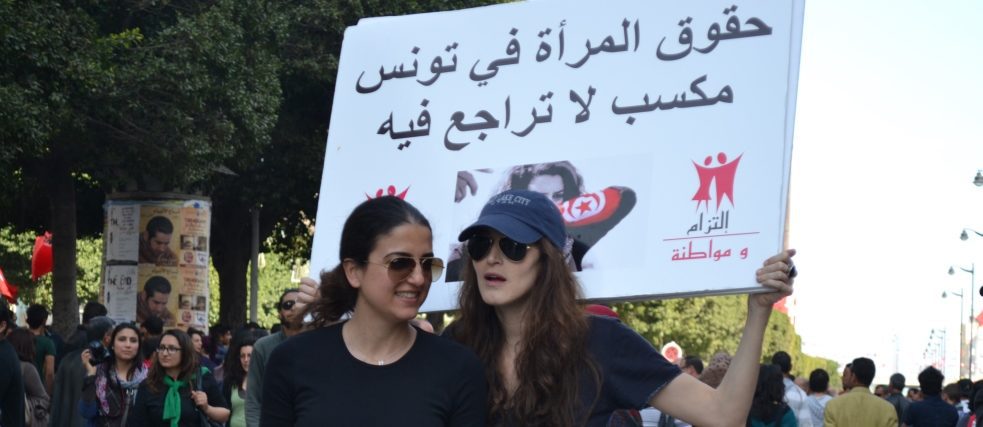
Protest in Tunis in spring 2012 against the conservative-Islamic Ennahda party | ©Aya Chebbi
In 2011, the world felt inspired by the power of the Tunisian people that toppled its decades-long authoritarian regime and sparked a wave of citizen action throughout the region and the world. The international community then noticed the presence of women at the forefront of these movements, challenging the widespread preconception of a region devoid of women’s activism.
By Aya Chebbi, Former African Union Youth Envoy and Chair of the Nala Collective
The reality was, indeed, much more complex. Women in Tunisia and the region had been fighting for social change, equality, and democracy for more than a century. This decade, however, sees the emergence of a generation of women who use new means to fight for their rights and face their various struggles.
Since the revolution, women have been occupying public spaces to organise and stand up for civic causes. In the words of Mike Douglass, however, the mere existence of “a public square, park or other spaces that appear to be civic spaces is not necessarily an indication of opportunities for civil society to engage in political discourse or action.” The dictatorships in the region, such as in Tunisia, Egypt, or Libya, have shown that civic spaces are colonised by the State or combinations of State-private enterprise control. For the civic space to be effective, it also has to be democratic.
The civic space in Tunisia has overwhelmingly been men’s domain, often reducing women to objects of struggle in the face of growing emphasis on Islamic values and customs, such as veiling, on the pretext of safeguarding Tunisia’s culture and morals after decades of colonial rule. Nevertheless, Tunisian women have continued to challenge discriminatory practices, advocate their rights, and transition from “objects of struggle to speaking subjects.” Since the early 20th century, Tunisian women have played a key role in organising civil resistance. In the 1930s, they joined the independence movement, holding protests and signing petitions. In the 1950s, women were fully active in the struggle for liberation, demanding rights and providing logistics and support.
However, the turning point for Tunisian women came about on 13 August 1956, which marked the promulgation of the Code of Personal Status (CPS) that included progressive laws aiming at the institutionalisation of gender equality, most notably through the abolition of polygamy and legalisation of abortion. It also granted women the rights to have their own passport, bank account, and even a business. Since then, Tunisian women have been portrayed and perceived in the region as independent and emancipated.
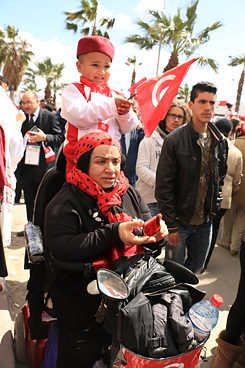
Protest in Tunis in spring 2012 against the conservative-Islamic Ennahda party | ©Aya Chebbi
This image was exploited by both former presidents to design a democratic façade. Under Habib Bourguiba’s administration (1959–1987) Tunisia was promoted as a secular republic in a region otherwise dominated by Islamic monarchies and military dictatorships. However, even the CPS was in the end a symbol of repressive progressiveness: while it mirrored institutional steps to improve the status of women, the progress was on Bourguiba’s terms only. The emancipation of women was thus credited solely to the allegedly feminist State and Statesman Bourguiba, who oversaw the feminist struggle in order to claim its achievements for himself.
Ironically, the portrait of Tunisia as a country spearheading the promotion of women’s rights is contested by the very figures produced by the State itself. For instance, according to the National Office for Family and Population (ONFP), almost 50 per cent of Tunisian women have experienced some form of violence in their lifetime. And in a study conducted by the Center for Research, Studies, Documentation and Information on Women (CREDIF) between 2011 and 2015, 53.5 per cent of interviewed women reported to have experienced physical or psychological violence in a public space at least once.
Despite these challenges, increasing efforts on the part of women reveal a growing awareness of their role in influencing the political system and conquering civic spaces. There are many means and methods that women’s rights activists and organisations are employing to this end. In the following, I will highlight four of them.
First of all, women are reclaiming public spaces that are a symbol of gender segregation, for instance coffee houses, which are usually frequented by men only. They are also challenging religious and historical constructs of male-only spaces. Most notably, in 2013, a large number of women joined a ceremony reserved to men in the Islamic tradition, namely a gathering on the cemetery to pay their last respects to the assassinated prominent politician Chokri Belaïd.
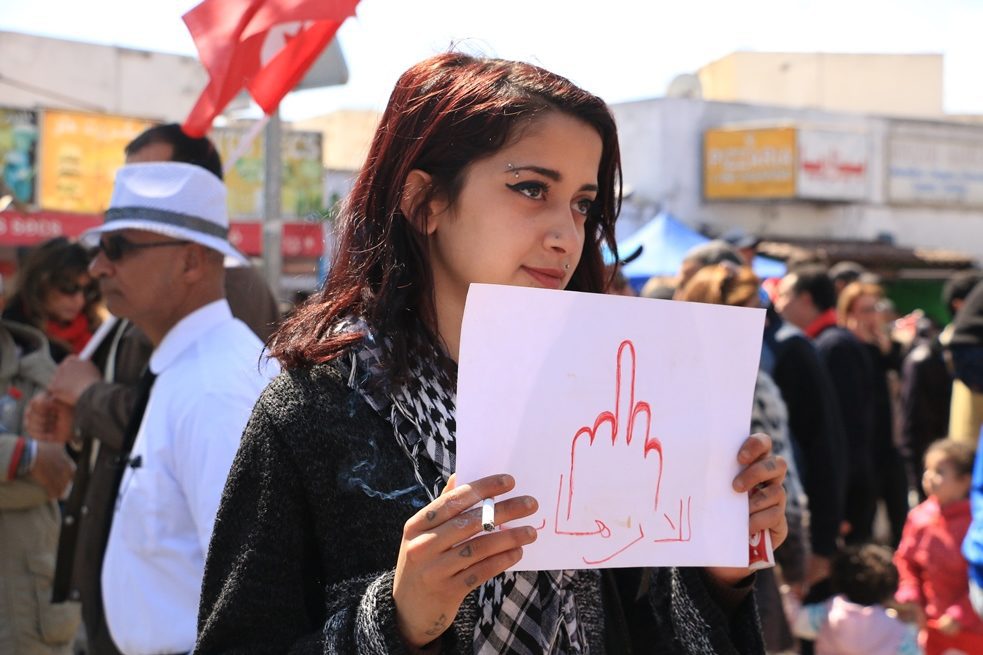
Protest in Tunis in spring 2012 against the conservative-Islamic Ennahda party | ©Aya Chebbi
Moreover, street art has emerged as a powerful form of expression and resistance. Feryel Charfeddine chose graffiti to claim civic space and became the first woman to leave a tag on the walls of Tunis under the authoritarian regime. In 2012, she co-founded the grassroots movement Zwewla (Tunisian dialect for “the poor”), which uses graffiti art, murals, and music to reflect on the reality of the working class (zwewla) and help them defend and claim their rights. “We express the reality of zwewla and raise awareness about marginalised classes through our graffiti on the streets and in public spaces where marginalised people live,” Charfeddine explains.
Many obstacles stand in the way of women creating and enjoying art, such as patriarchy, racism, elitism, and lack of education, which is why it is important to create inclusive movements and initiatives. Street art is such an inclusive type of initiative as anyone can engage with it, if only by reacting or adding lines to it. “My first act of tagging on the wall was a response to a lack of public space available for women’s expression in the streets, a problem that was linked to the dictatorship before and nowadays to the predominance of Islamic discourse,” says Feryel.
The involvement of many feminists, as well as political, social, and civil society groups in the period of political transition resulted in one of the most progressive constitutions in the region that legally safeguards many rights of women. “Talk to the people you disagree with” is a mantra that feminists, in particular, referred to as their strategy when engaging in debates with Islamic Conservatives during the constitution-drafting process.
For instance, while Conservative-Islamic politicians were initially against gender equality, they later voted in favour of it. Feminist groups organised advocacy events that gathered civil-society representatives, policy-makers, and parliamentary members to debate equality as fundamental principle of the constitution.
Thanks to local women groups, ensuring the participation of civil society in the constitution-drafting process, the new constitution, approved on 27 January 2014, is considered one of the most advanced of all South and East Mediterranean countries in political transition, especially in terms of civil liberties.
On the same question of equality, another means used by the feminist movement has been direct action, or more precisely: demonstration. On 13 August 2013, the National Day of Women and anniversary of the promulgation of the CPS, when Islamic Conservatives refused to discuss and change the newest draft of the constitution, women’s rights activists decided it was not a day of celebration, but of civic action. They thus took to the streets for a major demonstration to demand women’s guaranteed right to equality.
Posters and chants were calling for the revision of the draft, which even some of the 59 female MPs (42 from the Conservative Islamic party Ennahda) of the total 217 MPs had voted for. It stated that “the State shall preserve women’s rights and achievements under the principle of complementarity with men within the family and as partners of men in the development of the homeland.” It invoked notions of “complementary” gender roles that risked diluting the principle of equality between men and women.
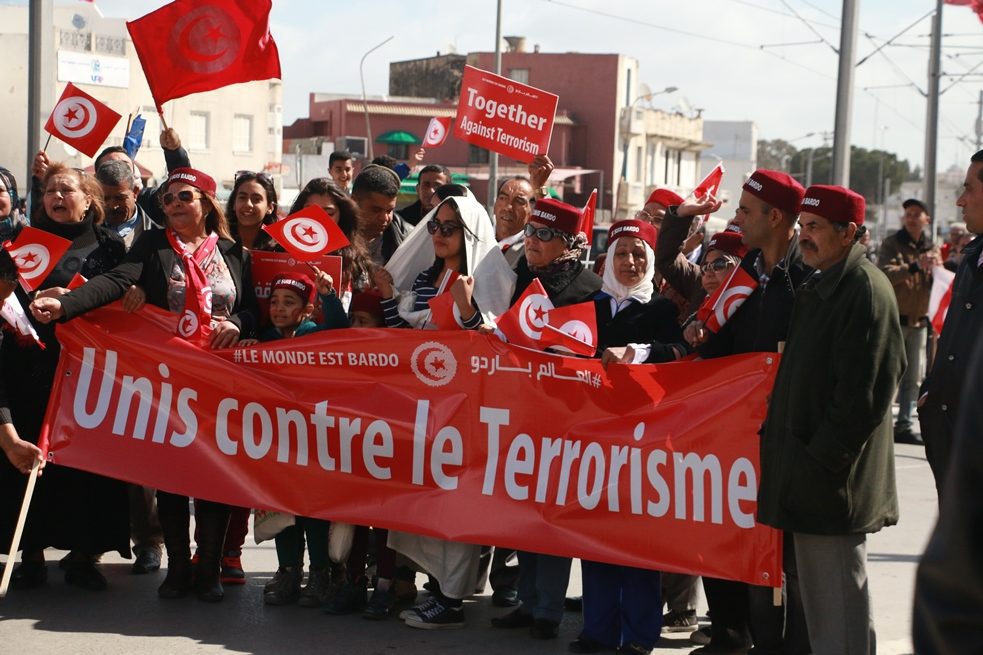
Protest in Tunis in spring 2012 against the conservative-Islamic Ennahda party | ©Aya Chebbi
Owing to the direct actions of feminists, who were able to mobilise the masses despite prior incidents of police violence and harassment of protesters, Article 46 of the Constitution now declares, “The State commits to protect women’s established rights and works to strengthen and develop those rights.” It further guarantees “equality of opportunities between women and men to have access to all levels of responsibility and in all domains” and “the elimination of all forms of violence against women.”
Women’s rights activists and movements continue to march, protest, and disrupt when necessary, at times in the shape of scattered, organically growing events, and other times organised by the Association Tunisienne des Femmes Démocrates (ATFD) or the Association des Femmes Tunisiennes pour la Recherche sur le Développement (AFTURD). They refuse the dilution of our rights and shrinking of our civic space, and push the Government to turn its attention to the pressing issues, such as the economy, one of the key reasons that had sparked the revolution.
The promotion of solidarity and building of alliances define the most important contours of the Tunisian feminist movement. In fact, the Tunisian lesson is that feminist movements in predominantly Muslim countries are most effective in reclaiming civic space when banding together with other movements, such as those concerned with workers’ rights and trade unions, marginalised groups, or climate change. This way, women’s issues become interwoven with all aspects of society.
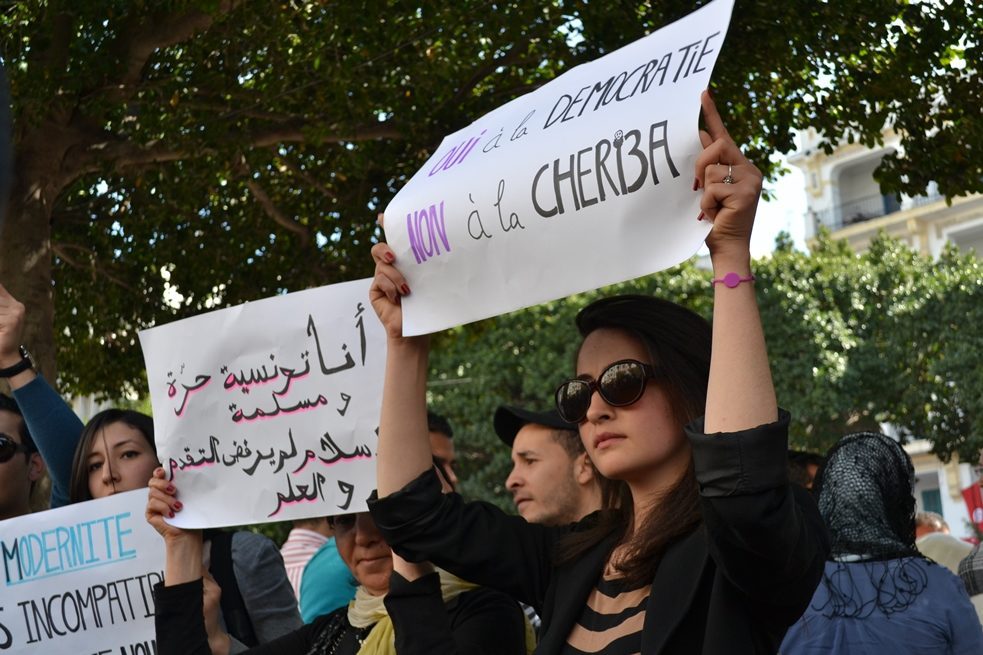
Protest in Tunis in spring 2012 against the conservative-Islamic Ennahda party | ©Aya Chebbi
The defeat of the Conservative-Islamic Ennahda Movement in the general elections of 2014, for example, came largely as a result of the public debate about women’s rights engaging large sections of the population. More than one million women decided to reclaim civic space and voted against Ennahda because of their belief in women’s rights. The gender advocacy battle is, therefore, strongly linked to the causes of social, political, and human rights in general.
Tunisian women have achieved notable legislative and political accomplishments. Organised women’s groups in Tunisia were at the heart of drafting the constitution and reforming the electoral law to foster vertical and horizontal equality. Regardless of how Tunisian women chose to face the challenges of political transition, our movement was successful in reversing the decrease of civic space and challenging Conservative-Islamic opposition to progressive legislation. During elections and crises, the resilience of feminist organisations and activists

Ten years ago, young women like myself took to the streets and changed the course of history in what you might know as ‘the Arab Spring’.
However, that’s a Western narrative. We call it the “Revolution of Dignity” because we protested for ‘Jobs, Freedom and Dignity.’ It has always been a revolution for economic justice led by women and youth.
Poverty is sexist. Today, young African women are enslaved in human trafficking. In Malawi, young women are subject to trafficking to South Africa and to the north of Europe.
READ MORE Egypt: 100 years of emancipation, women still fighting for change
This reality doesn’t differ for young women from across the continent, with exploitation being perpetuated within Africa and outside.
Hunger and poverty are pushing young women to die in the Mediterranean, in their search for livelihoods. Once they reach European shores, they find sexist, discriminatory and xenophobic laws. Perhaps technology is the only advantage and progress young women have had since the Beijing convening in 1995. However, despite the opportunities which the digital economy provides, one must recognise that 70% of Africa is offline. This is not only due to lack of internet signal, but because many people cannot afford to be online.
This is not business as usual, it is intersectional. As such, the current realities exacerbated by a global pandemic cannot be fixed by creating jobs or by merely teaching girls how to code.
READ MORE History: ‘Unruly’ African women who made their mark on the continent
Poverty cuts across the digital divide, exploitation and border policing which halt young women’s livelihoods. We are in urgent need of a recovery plan that does not “build back” better the economy, but rather “build forward”, with equity and feminist economics.
We are equal before the virus, it does not segregate based on gender, skin colour or nationality, but the virus also showed us how much our systems are unequal, how patriarchy uses violence as a weapon to keep women trapped in an inequality that decides a woman refugee cannot secure a job or a woman with a disability cannot access digital technology.
We have seen that Covid-19 recovery plans have left many women who are at the forefront of managing the pandemic, from health workers to caregivers, at the margins and peripheries of policy formulations or government support.
Economic, political, social, ecological and digital justice requires a new approach to leadership that is gender and generational inclusive. My generation is calling for Intergenerational Co-Leadership.
READ MORE Coronavirus: African women bear bigger brunt of the pandemic
We cannot inherit systems we didn’t co-design. African youth are the youngest population in the world. As estimated by the World Bank, the African continent will reach one billion by 2050 and become the world’s largest workforce – one that currently has very few economic opportunities.
The informal and low-paying labour market, where most of Africa’s young women work, are affected the most by the pandemic. In Nigeria, for instance, 45% of people mentioned that they had stopped working by the middle of 2020, while in Uganda, the figure was 17%.
Equality is about the girl child, who is denied education and is making a life for herself in the market, at risk of teen pregnancy and HIV/AIDS.
The same risks exist when government policies put her at home in lockdown without protection. In front of a pandemic, we’re all the same. We are equal before the virus, it does not segregate based on gender, skin colour or nationality, but the virus also showed us how much our systems are unequal, how patriarchy uses violence as a weapon to keep women trapped in an inequality that decides a woman refugee cannot secure a job or a woman with a disability cannot access digital technology.
At the beginning of July, at the Generation Equality Forum, $40bn were pledged to achieve gender equality with a roadmap for the next five years, through commitments that cut across six Action coalitions, and the Women, Peace and Security and Humanitarian Action.
However, in order to achieve this, funds must be channelled directly to women and girls who are the most vulnerable, and to the grassroots who are the most aware of the context-based challenges and solutions.
READ MORE Uganda/Kenya: Women traders hit hard by ‘COVID-19 nationalism’
We cannot afford to remain bound within neocolonial and patriarchal structures that have made young women’s contributions to society invisible.
African governments, Generation Equality leaders, and the private sector must be ready to co-lead with youth, and with young women. World leaders cannot turn a blind eye to the dilapidation of African countries’ infrastructures, which are directly impacted by their decisions and policies, making climate change be among the primary causes of girls being left out of school. Can we re-imagine what the world would look like if women are counted in the economy, if we own the means of production, if we are intellectual, if our physical and maternal labour is free from servitude?
We need to stop talking about Gender Equality and start funding Gender Equality. It is ironic that whenever youth and grassroots organisations demand funding for the gender agenda, they are told that there has been a “budget cut” or there isn’t
“enough”.
But why is it that there are no budget cuts to dig up fossil fuels to destroy the planet? Why is it that when there is a terrorist attack in the Sahel region, countries fund militarisation but do not fund 20 million girls in the Sahel married before 18 with no economic opportunity?
We have seen how the Boko Haram crisis in the Lake Chad Basin continues to impact young women’s subsistence, leaving them without any sources of income.
READ MORE Nigeria: ‘Boko Haram was funded and inspired by Bin Laden’ – Zenn
Young women traders had to leave their farms, formal and informal economic activities to attempt to find safety in neighbouring villages, only to find themselves refugees and displaced, with low water access, experiencing further gender-based violence and human trafficking.
The efforts put into Silencing the Guns so far continue to overlook the urgency for funding and supporting young women peacebuilders and organisations, and specific young women programmes at the intersection of Youth, Peace and Security and Women peace and Security agendas. It is all happening at the grassroots level.
We need to change the system because the current neocolonial, racist and patriarchal system does not work for us. We, as young women, are ready to co-lead.
In fact, we developed the Africa Young Beijing+25 Manifesto with ten bold demands, co-created with more than 1500 young women and men from 44 African countries and over 30 partners.
The demands are intersectional, but each context has its own affinities and structural challenges. We launched at the Generation Equality forum in Paris: the Nala feminist collective, a group of 17 Pan-African feminists calling for change, driving the manifesto demands and rising as a united voice because generation equality cannot move forward without Africa. Eventually, eight out of ten of these demands were incorporated into Action Coalitions’ commitments.
World leaders have the historic responsibility now to make things right for the next five years. Instead of leaving half of humanity behind, we should leave patriarchy behind – once and for all.
SOURCE: https://www.theafricareport.com/107200/we-need-to-stop-talking-about-gender-equality-and-start-funding-it-instead/

African women continue to struggle to find the right spaces to speak and share the realities of our generation. We do not lack bravery or confidence, but advocacy spaces that would engage our stories with kindness and actual solutions. Our feminist ancestors have taught us that what brings us together is our Pan-African solidarity. As African women, we will not allow anyone to keep us quiet. We know and recognize that the future cannot be just, peaceful and equal if young women and girls remain subject to gender-based violence such as female genital mutilation/cutting (FGM/C), other forms of domestic violence and femicide. Enough is enough. African women want and expect to be freed from the societal misconceptions which fuel the prevalence of FGM/C.
It was groundbreaking to bring together 1,500 young people from across the continent during five Africa Young women Beijing + 25 virtual regional barazas (or convenings) hosted by the African Union Special Envoy on Youth, Aya Chebbi, in November 2020. The barazas opened up a space for sharing and speaking on the issues that challenge African women’s access and mobility spatially and socially. This was based on the premise that Africa’s women do not need anyone to speak on their behalf. They have voices and demands that must be heard and acted upon with the respect they deserve. The regional consultations culminated in the Africa Young Women Beijing + 25 Manifesto—a revolutionary feminist document that carries 10 bold demands. These are the hopes and aspirations that come to exist against sexist national laws, marginalization, and the lack of economic justice.
As expressed by Africa’s young women, FGM/C remains a tool used to oppress their bodies—as an act of gender-based violence which many women have been forced to remain silent about for decades. Unlike other spaces, the manifesto was not built upon the problematic framing which discusses women’s issues without giving them agency. Instead, it was created through their inputs, generous sharing, radical honesty and listening.
What about the other demands? FGM/C interlinkage with other forms of inequalities must be recognized. Each of the Manifesto’s 10 Demands provides an important roadmap to re-affirm that liberation pathways for young women are multi-layered and include demanding the provision of legal, physical and psychological support, shelters and specialist services to women subjected to all forms of violence, to demanding the removal of taxation on menstrual products, enforcement of progressive period policies in all workplaces, and the provision of free sanitary pads and sanitation in all schools.
African women and the 10 demands:
What binds the manifesto together is an equitable desire to center women’s voices within policy and decision making spaces in which they are absent— an absence that can be deemed violent. These are spaces in which African women are being spoken for, without inclusion. The Generation Equality Forum in Paris provides us, as the Nala Feminist Collective, with a unique opportunity to advocate for the implementation of these 10 demands. We are powered by African women’s words with a document that unites our voices, across urban and rural, online and offline spaces.
Our Nala Council is made of 17 feminists with a mission to foster, enable and mobilize young women from Africa and the diaspora, bridging the gap between policy and implementation, intergovernmental and grassroots organizations, as well as generational spaces.
Together—not without Africa’s young women.
Join our advocacy. We have launched our 10,000 Signature Campaign. We need your support. The fight cannot be solo. Lend your voice to African young women and sign the Manifesto.

We are Anti-Romanticizing creativity and Innovation
Africa doesn’t lack innovation or creativity. African women have proved it. Creativity for survival, creativity in advocacy and resistance. Women as active producers for liberatory possibilities have not gone unnoticed. Yet, what underpins the creative and innovative endeavors are deep inequalities, hierarchies of differences and politics of exclusion. Young African women have said enough is enough. The care economy has fallen short of support. It has failed a generation of young women forced to pour their labor into securing food and leading households. The compromise was clear: creative versus basic needs. Young African women are threatened by erasure from narratives, spaces, digital and creative revolutions.
10 Demands #UnleashingPotential
We have come together, listened, and acted.
During her tenure of office as African Union Special Envoy on Youth, Ms.Aya Chebbi convened 5 regional consultations, North to West, South to East. Joined by civil organisation and grassroot movements, 1500 young women and men outlined their contextual challenges resulting in the African Young Women Beijing+25 Manifesto. The Manifesto sets out 10 demands for the Generation Equality Forum with a clear message: Enough is enough. The demands on the right to digital freedoms and economic justice, among others, can untie the patriarchal bonds challenging women’s liberation. When the Young women and men showed up, they reiterated their commitment for collective action to achieve gender equality. What remains of critical urgency is the timeframe by which the 10 demands will be met. Support the demands. Sign the manifesto.
Against the Erasure of Women’s voices from creative economies
Young African women choose creativity as a route for survival. This emerged not just through the demands of the Africa Young Women Beijing+25 Manifesto, but also in the work of 25 pioneer young African women featured in the first feminist publication of the African Union in October 2020. The publication and blog Sauti صوتي provided a platform to widen the reach of the 25 women’s impact on their communities. Their stories depict aspirations for leadership—to innovate and to live with dignity. This Africa is where the future is young and female, and it is this belief driving the mission and vision of Nala.
SOURCE: 10 Critical demands to unleash Young African Women’s creativity
